Add: R503-506, Hongxi Commercial Building. No.23 Guantai Road. Nancheng District, Dongguan City, Guangdong Province, China.523000
Add: R503-506, Hongxi Commercial Building. No.23 Guantai Road. Nancheng District, Dongguan City, Guangdong Province, China.523000


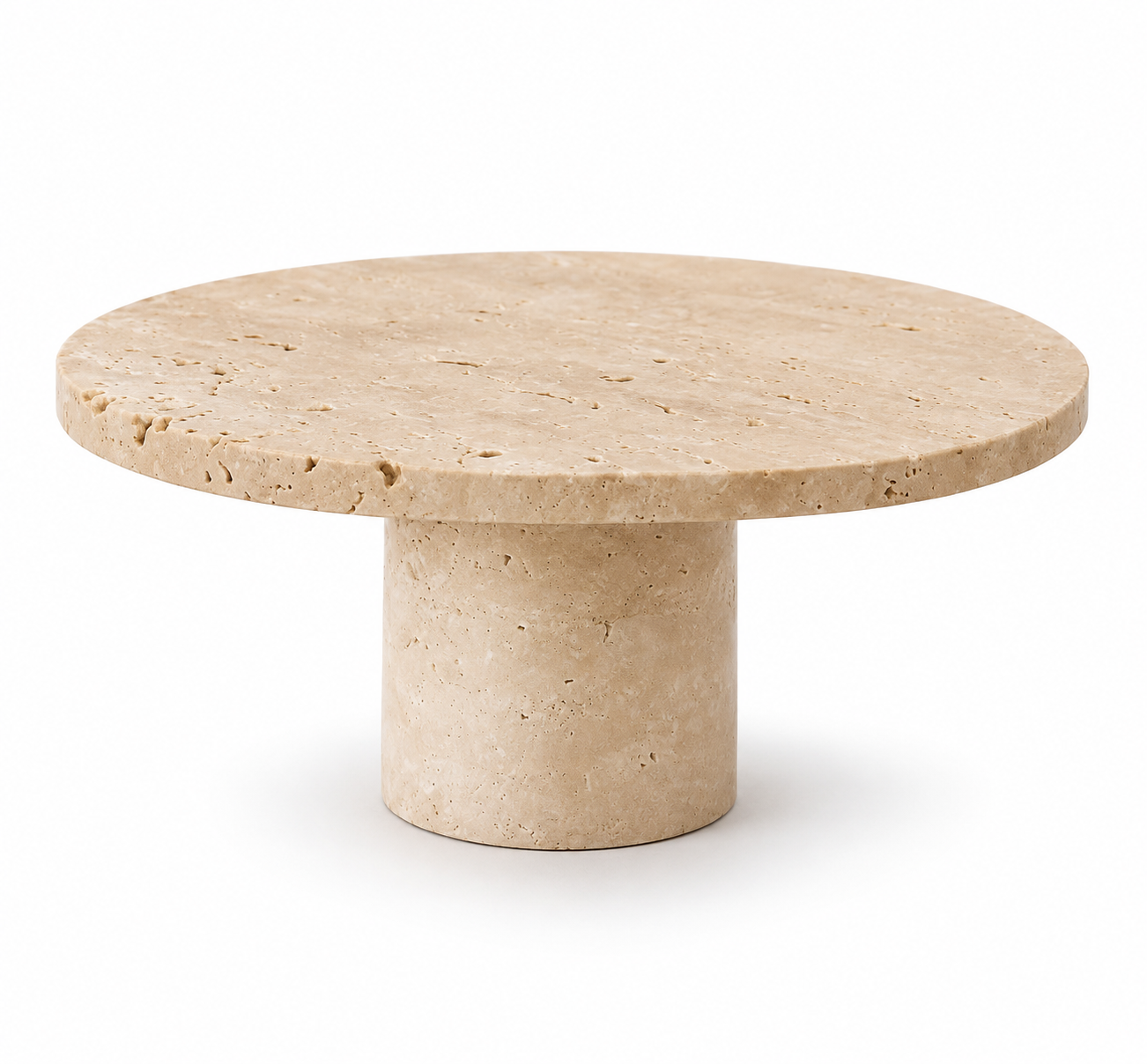
A travertine cake stand is easy to fall for in a photo and harder to buy with confidence. The warm beige stone, the weight, the quiet luxury: your customers see all of that straight away. What you have to judge is different. Will the colour hold together across a full order? Will heavy stone survive the journey to your warehouse? Can you get the size and finish your channel actually needs, in a quantity you can test? And if food sits on it every day, will it stain, and what do you tell the end customer?
This guide answers those questions one by one. It is written for wholesalers, retailers, interior designers and hospitality buyers who are considering a natural stone cake stand for cakes, patisserie, cheese, fruit and display, and who need the risks dealt with before they commit, not after the cartons arrive.
Travertine fits the direction home and hospitality styling has already taken: warm neutrals, matte natural materials and fewer, better objects on the table. Unlike a printed or coated stand, the interest is in the stone itself, so the piece works in a bakery display, on a hotel buffet, in a wedding tablescape and on a kitchen counter without needing a trend-led pattern that dates quickly.
For a range buyer, the commercial point is just as important. One stand does several jobs: cake and dessert service, a raised fruit or cheese board, a counter display for patisserie, and a pedestal for candles, vases or retail merchandising. That multi-use story is easier to sell, easier to photograph and easier to reorder than a single-occasion piece. It also sits naturally beside other travertine in a collection, such as a travertine tray, a travertine vase and a travertine candle holder, so a customer can build a set instead of buying one item.
This is the first worry with any natural stone, and it is a fair one. Travertine is a natural limestone formed around mineral springs. Its pores, soft veining and beige tones are created by the stone, not printed on, so no two stands are identical. A buyer who expects ceramic-style uniformity will be disappointed; a buyer who sets the standard correctly will get a range that looks coherent and genuinely natural.
How to handle it before you order:
Our approach is to confirm the tone and finish against an approved sample before a bulk order, and to keep stone selection within that agreed range. Tell us if your channel needs a tighter, more uniform selection or a more rustic, heavily pitted look, because those are different selections and they need to be agreed at sample stage.
Weight is part of why a stone stand feels premium on the table, and it is also the biggest logistics risk. Most breakage does not happen because travertine is fragile in use; it happens because a heavy top and a solid pedestal base were allowed to move, knock or take a drop inside weak packing.
Ask any supplier, including us, these questions before you pay a deposit:
We coordinate production follow-up and quality inspection, and pre-shipment photos let you check the finish and packing before the goods leave. Share your destination, order volume and whether you ship by sea, air or courier, and ask for the packing method to be confirmed for that route. A small trial order is also a practical packing test: you see exactly how the stands travel before you scale the quantity.
A cake stand that is too small for a standard celebration cake, too tall for a display cabinet or too heavy for your freight budget will not reorder, however beautiful it is. Diameter, height, base shape and finish all need to fit your channel: patisserie and hospitality buyers usually need a generous, stable top and a wipe-clean working surface; gift and home retailers often need a lighter footprint and shelf-ready packaging; designers may need a specific height to complete a tablescape or buffet level.
Before you request a quote, decide and share:
Creative Power supports custom sizes and finishes through OEM and ODM development, from a drawing, reference image or physical sample, with sample development before bulk production. Our website range starts with low minimums and mixed orders across categories, which lets you test a travertine cake stand alongside travertine trays, vases and candle holders in one shipment instead of betting a full order on a single design. Tell us the size and quantity you have in mind and we will confirm the workable minimum, sample cost and price for that specification, rather than quoting a generic size you do not want.
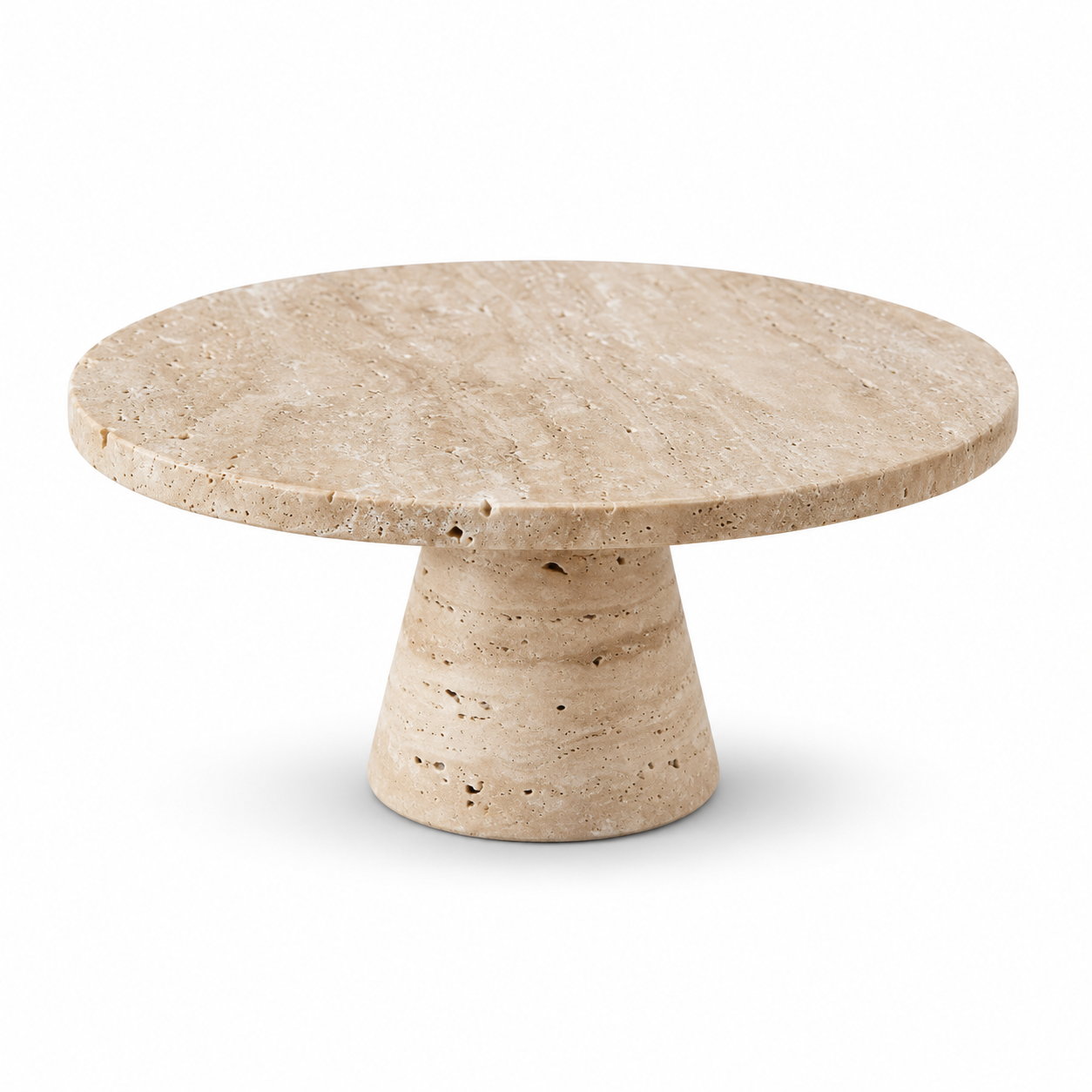
| Cylindrical base (Image 1) | Tapered base (Image 2) | |
|---|---|---|
| Look | Clean, architectural, modern | Softer, sculptural, lighter |
| Best for | Hotels, bakeries, modern retail | Home retail, weddings, designers |
| Feel on table | Solid and grounded | Raised and elegant |
| Styling | Minimal, contemporary schemes | Warm, organic, layered tables |
Both stands share the same selling points: a flat round travertine top, a honed matte beige finish and visible natural pores and veining. Many buyers stock the cylindrical base as the core line and add the tapered base as the design-led option, which gives the range choice without doubling the sourcing work.
Yes, travertine is porous, and any supplier who tells you it behaves like glazed ceramic is setting you up for complaints. The stone can absorb water and oil if spills are left to sit, and because it is calcium-based, acids such as vinegar, lemon juice and acidic cleaners can dull or etch the surface. None of this stops it being a very good serving piece. It just needs the right protection and honest care guidance, which is also what protects your reviews and repeat orders.
For retailers, put a short care card in the box. It takes one line on staining, one line on cleaning and one line on resealing when water no longer beads on the surface, and it prevents most of the “it marked on first use” conversations. Hospitality buyers should add the same points to staff training: serve on boards for long buffets, blot spills promptly and keep acidic dressings in separate vessels.
A stand that sells through is only useful if you can reorder the same tone, finish and size in time for your next season, event calendar or store drop. Natural stone supply depends on material availability and production slots, so reliability comes from process, not promises.
Share your target delivery date and destination when you enquire, and we will work back from it: specification, sample, approval, production, inspection and shipment coordination. If a date cannot be met safely for the size and quantity you need, it is better to know at quotation stage, when you can still adjust the plan.
Travertine is a natural stone commonly used for serveware. For direct food contact, specify a food-contact-suitable penetrating sealer and finish for your market when you order, follow the sealer maker’s curing instructions before first use, and use a cake board or parchment under oily, acidic or strongly coloured foods during long service.
Unsealed travertine can absorb oil and coloured liquids if they are left to sit, because the stone is porous. A penetrating stone sealer slows absorption and gives you time to blot spills. Sealed travertine is more stain-resistant, not stain-proof, so prompt blotting and boards under wet or oily foods are still recommended.
Wipe it with a soft cloth and warm water, adding a drop of pH-neutral cleaner made for natural stone if needed, then dry it. Never use vinegar, lemon, citrus cleaners, bleach, descalers or abrasive pads, because acids and abrasives can etch, dull and scratch the stone and strip the sealer.
Yes. Custom diameter, height, base shape, finish, logo and packaging can be developed from a drawing, reference image or sample. Share the full specification and target quantity with your enquiry so the sample cost, workable minimum and bulk price can be confirmed for that exact design.
The minimum depends on whether the stand is a stock design or a custom size and finish. Creative Power offers low minimums and mixed orders across its home decor range, so you can test a cake stand together with other travertine pieces in one shipment. Send your size and quantity for a confirmed minimum and price.
The top and pedestal base should be protected separately so they cannot rub or knock, with export-strength outer cartons and palletising where the shipment needs it. Agree the packing method for your route, request pre-shipment inspection photos of the pieces and the packing, and confirm the remedy for transit damage before you pay a deposit.
If you are building a stone serveware range, start with the specification, not just a photo. Send us the diameter and height you need, the base shape you prefer, your target quantity and your delivery date, and tell us whether the stands are for retail, interior projects or hospitality service. We will confirm the size, finish, sealer, packing, minimum and lead time for that brief, and help with samples, mixed orders with matching travertine trays, vases and candle holders, inspection and shipment coordination.
Request a quote via our Contact Us page, or browse All Products and the Decorative Tray collection to build a mixed travertine order. The sooner the colour range and packing are agreed, the smoother the first order and every reorder after it will be.